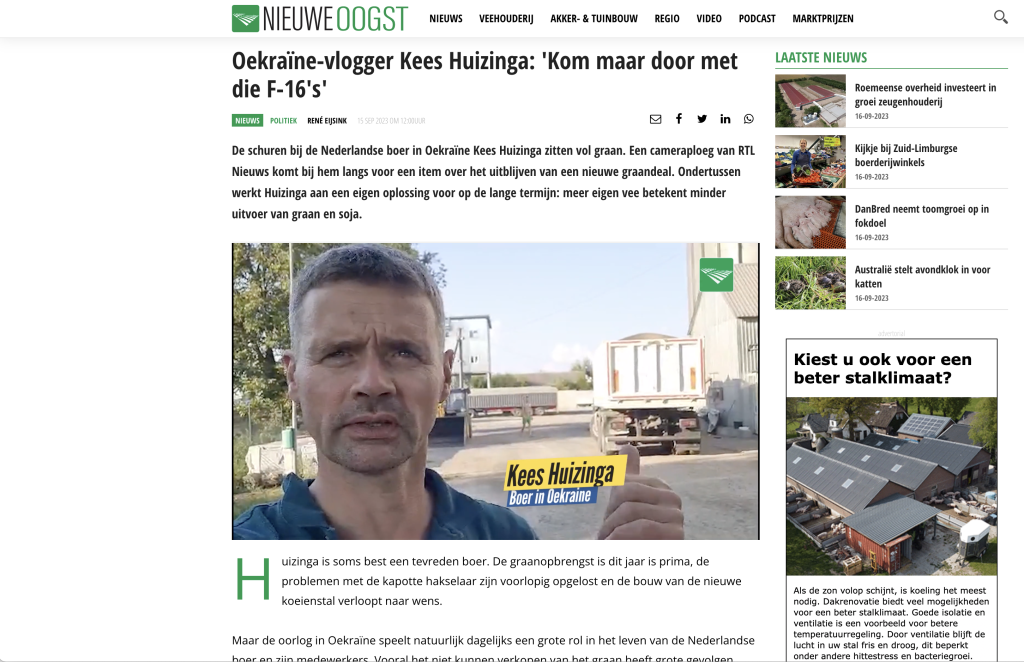
Kees Huizinga has farmed in Ukraine’s Cherkassy region for 20 years, and since the Russian invasion of his adopted home, Huizinga has also been a weekly correspondent for Nieuwe Oogst (New Harvest), a multi-media farm platform in his native Netherlands. In fact, notes Nieuwe Oogst editor-in-chief Esther de Snoo, Huizinga’s video reports from Ukraine start ringing up views the moment they are released each Friday at noon.
“Every week, it’s our biggest story,” says de Snoo. “We do a lot of video here for Nieuwe Oogst, but this is different. It’s from his own perspective. He makes it his own.”
A Window on the War
Huizinga operates TOV Kischenzi, a 15,000-hectare farm in central Ukraine milking more than 2,000 cows and producing wheat, barley, canola, sunflowers, sugar beets, corn, soybeans and vegetables. With a staff of 350 to 400 people, Kischenzi has been recognized as one of Ukraine’s most productive farms.
de Snoo reached out to Huizinga after following him on Facebook and Twitter in the weeks before the invasion. By that time, Huizinga had already been interviewed by Dutch consumer media and spoken at the Dutch Embassy to Ukraine about the farmers’ challenges there. Huizinga says he wanted people outside Ukraine to understand what was happening.
“Twenty percent of Ukraine’s GDP is farming; 40 percent of our hard currency comes from farming,” Huizinga points out. “Eighty percent of what we produce is exported. I saw this all being destroyed.”
Huizinga’s experience posting videos and statements on social media—as well as watching dozens of journalists that descended on Ukraine in the early days of the invasion—guided his reporting for Nieuwe Oogst. So did feedback from de Snoo, who provided comments on his reports and traffic statistics on each story. Equipment is minimal: Huizinga records video with his mobile phone, narrating as he shoots, and sends raw footage to the Niewe Oogst editing team for production.
de Snoo says Huizinga quickly became an excellent reporter despite not having trained as a journalist.
“I think Kees became more and more a storyteller,” she says. “The key has been to have lots of small videos, and create a very clear format. We release the videos every week at the same time. It’s more raw than our other materials, and I think that’s the power of this program. Kees is doing it his own, natural way.”
Farm Audience
Huizinga says he appreciates communicating to a farm audience and working with an editor who understands farming. His earlier experience working with interviewers from outside agriculture made it challenging to communicate how deeply Ukraine’s farm economy is threatened and how that impacts people around the world who depend on the nation for grain, sunflower oil, and other farm products.
“Every time you talk to journalists, you have to explain to them the principles of agriculture,” Huizinga says. “Nobody really has an idea of the amount of grain produced in Ukraine, or the logistics that are required to move it. We are exporting more than our neighbors in Poland and Romania produce. Those countries would have to double their railroad capacity to handle the grain we now cannot export through the Black Sea. And their ports are not designed to explore those huge quantities of grain.”
More than Clicks
Through his videos, Huizinga has brought Nieuwe Oogst‘s farmers to the idled ports on the Black Sea and given them a front-row seat to his decision to end pig production when the war upended the local pork industry. His frank descriptions of the challenges of keeping his farm running is a big part of Huizinga’s appeal, says de Snoo.
“Of course, we want to inform the world and the Dutch farmers about the situation of Ukraine and keep it in the news, but we also want to inspire them,” she notes. “Kees is an entrepreneur. It’s amazing to see how he’s finding his way to deal with this situation and to keep his farm alive. I hope it will inspire other farmers and give them more perspective and context also for their own situation.”
In addition to Huizinga’s weekly vlogs from the farm and agricultural sites around Ukraine, he and his wife Emmeke also coordinate humanitarian aid donated by Nieuwe Oogst‘s audience. From hundreds of bicycles to clothes, medicines and equipment, more than $8 million worth of donations to the Stichting de Leeuw Kyiv (Lion of Kiev Foundation) have helped Ukrainian refugees, farmers and military personnel. Leo Kiev also collected $2 million in funds.
“It’s not only for the clicks and views,” notes de Snoo. “We feel also the need to help by giving Kees and his wife a platform to send their message into the world.”
Kees Huizinga’s reporting for Nieuwe Oogst was awarded first prize in the Netherlands Association of Agricultural and Horticultural Journalism (NVLJ) contest in the Pioniers category, and nominated by the Dutch guild for the 2023 Star Prize. Click here and here for examples of his reports from Ukraine.